
|
|
 Home Page
|
|
Jimmy's Pages
|
||
 |
Welcome to Canada!! Ottawa is the capital in Canada.However,Toronto is a place where i'm living in,is bigger than it.Firstly,I'll introduce to you about Canada.Please follow me. Ontario Introduction With so much to explore, Ontario is as difficult to cover in one vacation as it is to describe in one sentence. It manages to include both Canada's most populous city (Toronto) and areas so remote that polar bears outnumber humans. It has tranquil farm country in the south, but in the midst of that rural landscape is Stratford and Niagara-on-the-Lake, two small towns that stage some of the finest theater in North America. There's an incredible wealth of water -- four of the five Great Lakes, the St. Lawrence and Ottawa Rivers and 200,000 inland lakes. And there's Niagara Falls, the most famous water spectacle of them all. |
|||
|
This is a "City TV";where u should travel,next to China Town If u wanna get more information about Canada for your travelling,please click a link.(under) http://www.travelcanada.ca/travelcanada/app/en/ca/home.do |
||||
|
Secondly,I'll tell you about Ontario's history Much of Ontario's natural splendor can be traced to the Ice Age, when glaciers carved the Great Lakes and the melting ice left the province a watery land. Paleo-Indians populated the region while hunting for large game. At the time of European contact, there were various tribes who spoke the Iroquois language -- Iroquois, Huron, Petun, Neutral, Erie and Susquehannock -- living along the shores of Lake Erie and Lake Ontario. They supported themselves by farming, fishing and hunting and lived primarily in permanent, densely populated villages of bark longhouses. Farther north, the Ottawa lived along the Ottawa River Valley. The Cree, Ojibway, Nippissing, Mississauga and Algonquin inhabited northerly parts of the province. Because it was too cold to cultivate crops, they depended on trapping, fishing, foraging and hunting. French explorer Samuel de Champlain traveled up the Ottawa River in 1613, opening the principal fur-trade route to the upper Great Lakes. The presence of European trade changed the Native Americans' lifestyle and aggravated tensions between the Algonquin tribes and the Iroquois. In the mid 1600s, a massive Iroquois offensive drove the Algonquins out of southern Ontario and disrupted the fur trade for a time, though the French were able to re-establish trading posts and forts in the late 1660s.
When France ceded its dominion over Canada to Great Britain in 1763, Ontario quickly became one of the Canadian provinces most closely tied to England. In the 1770s and 1780s, loyalists fled to Ontario from the 13 rebellious American colonies. They were later joined by more immigrants from the U.S., who came to claim some of Ontario's plentiful land. The province's location on the Great Lakes made it a flashpoint in the War of 1812, when Britain and the young U.S. went to war a second time.
As immigrants (especially from England, Scotland and Ireland) poured into Ontario in the 1800s, the pressure mounted for political reform and some sort of clear status for the region: Until then, Ontario and Quebec were divided into a vague pairing of Upper and Lower Canada, respectively. The newspaper editor and firebrand William Lyon Mackenzie successfully focused attention on the problems -- his short-lived rebellions were a key factor in the ultimate confederation of Canada in 1867.
Since that time, Ontario has emerged as one of the most important areas of the country: Ottawa serves as the nation's capital, Toronto is Canada's largest city, and the province has amassed great wealth from its mineral resources, heavy industrialization, forestry, agriculture and fishing.
|
||||
|
|
||||
|
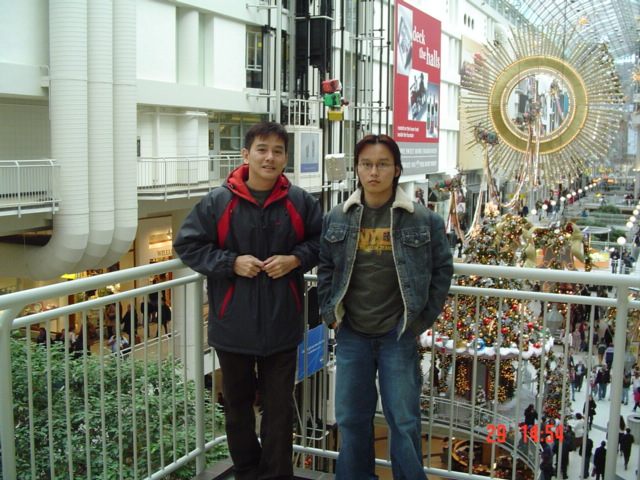
My Uncle and Me A photo was taken in Eaton Mall Centre.It's the biggest mall on Yonge&Dundas streets,in Toronto,Canada. |
 |
|||
|
|
||||